
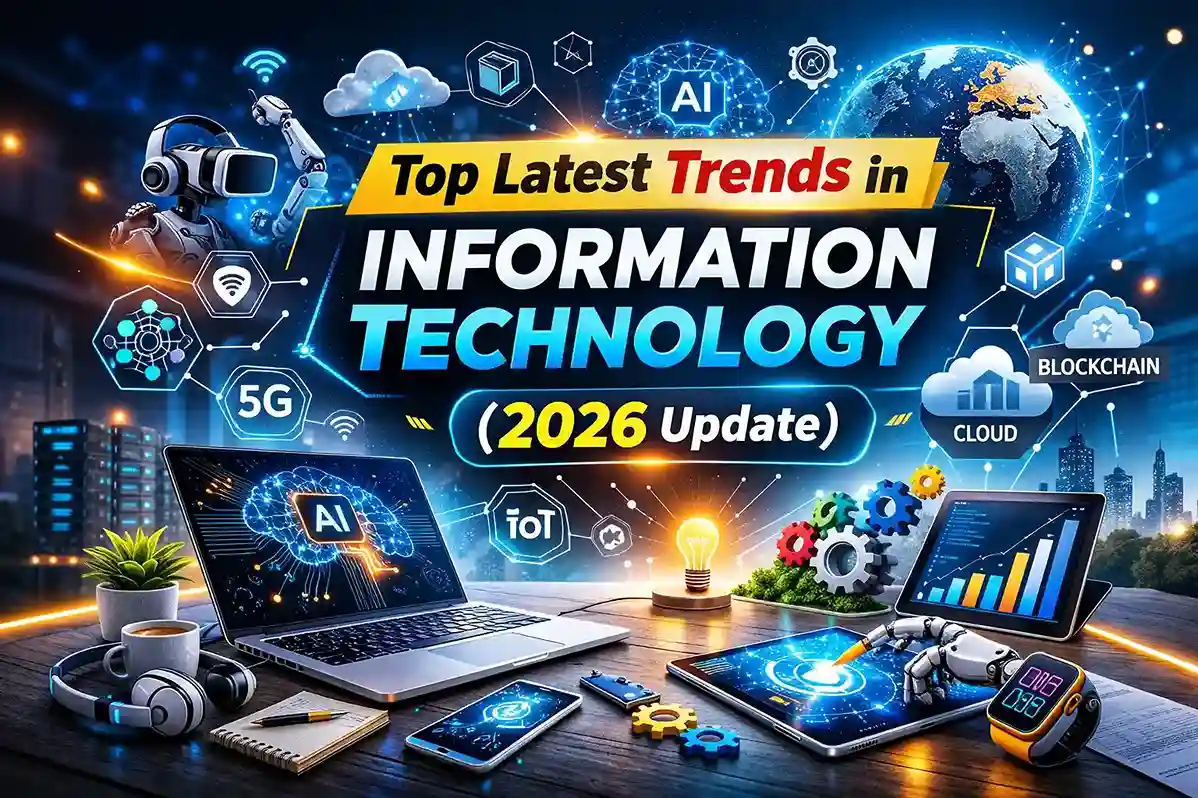
Technology is evolving faster than ever and staying updated has become essential for students, professionals and businesses alike. The latest trends in information technology are shaping how we work, communicate and solve real-world problems. From artificial intelligence to cloud computing, these innovations are not just trends—they are transforming the future.
In 2026, we are seeing a shift toward smarter systems, automation and data-driven decision-making. Understanding these changes can help individuals stay competitive and businesses remain relevant in a rapidly changing digital world.
In this article, we will explore the latest trends in information technology that are dominating 2026 and beyond.
1. Artificial Intelligence and Machine Learning Expansion
Artificial Intelligence (AI) and Machine Learning (ML) continue to lead the latest trends in information technology. These technologies are now more advanced, accessible and integrated into everyday applications.
AI is no longer limited to big tech companies. Today, businesses of all sizes are using AI-powered tools for automation, customer support and data analysis.
For example, chatbots are now capable of handling complex customer queries, while AI-driven analytics tools can predict market trends and customer behavior.
Key applications include:
- AI-powered virtual assistants
- Predictive analytics in business
- Automated content generation
- Personalized recommendations
Machine learning is also widely used in healthcare for disease prediction and in finance for fraud detection.
2. Rise of Generative AI
Generative AI has become one of the most talked-about trends in information technology in recent years. Unlike traditional AI, generative AI can create new content such as text, images, videos and even code.
Tools powered by generative AI are now used by content creators, developers, marketers and students.
For example, a student can generate summaries of long chapters, while developers can write code faster using AI-assisted tools.
Why generative AI matters:
- Saves time in content creation
- Enhances creativity
- Assists in coding and development
- Improves productivity across industries
This trend is expected to grow even further as AI models become more powerful and accurate.
3. Cloud Computing and Multi-Cloud Strategies
Cloud computing remains a core part of the latest trends in information technology. Businesses are increasingly moving their data and applications to the cloud for better scalability and flexibility.
In 2026, many organizations are adopting multi-cloud strategies which means using services from multiple cloud providers instead of relying on just one.
This approach helps improve reliability and avoid dependency on a single platform.
Benefits of cloud computing:
- Remote access to data and applications
- Cost-effective infrastructure
- Easy scalability
- Enhanced collaboration
For example, companies can store data on one cloud platform while running applications on another, ensuring better performance and security.
4. Cybersecurity Advancements
With the increase in digital transformation, cybersecurity has become one of the most critical trends in information technology.
As cyber threats become more sophisticated organizations are investing heavily in advanced security solutions.
Modern cybersecurity focuses not only on prevention but also on detection and quick response to threats.
Important developments include:
- AI-based threat detection
- Zero Trust security models
- Biometric authentication
- Cloud security solutions
For instance, banks now use AI systems to detect unusual transactions in real time, helping prevent fraud.
Cybersecurity is no longer optional—it is essential for protecting data and maintaining trust.
5. Internet of Things (IoT) Growth
The Internet of Things (IoT) is another major area in the latest trends in information technology. IoT connects everyday devices to the internet, allowing them to collect and exchange data. From smart homes to industrial automation, IoT is transforming how devices interact with each other.
Common IoT applications:
- Smart home devices (lights, thermostats)
- Wearable fitness trackers
- Smart cities and traffic systems
- Industrial IoT in manufacturing
For example, smartwatches can track health metrics like heart rate and sleep patterns, providing valuable insights to users.
As IoT devices continue to grow, they are making life more convenient and efficient.
6. Edge Computing
Edge computing is emerging as an important part of the latest trends in information technology. Instead of processing data in centralized cloud servers, edge computing processes data closer to the source. This reduces latency and improves performance, especially for real-time applications.
Why edge computing is important:
- Faster data processing
- Reduced network congestion
- Improved performance for real-time apps
- Better data privacy
For example, in self-driving cars, data must be processed instantly. Edge computing ensures quick decision-making without relying on distant servers.
7. 5G and Next-Generation Connectivity
The rollout of 5G technology is accelerating many of the latest trends in information technology. With faster speeds and lower latency, 5G is enabling new possibilities in communication and data transfer.
Impact of 5G:
- Faster internet speeds
- Improved streaming and gaming
- Better support for IoT devices
- Enhanced remote work capabilities
For example, 5G allows smooth video conferencing and real-time collaboration without lag which is crucial for remote teams. As connectivity improves, digital experiences will become more seamless and efficient.
8. Blockchain Technology Beyond Cryptocurrency
Blockchain is no longer limited to cryptocurrencies. It has become one of the key trends in information technology for secure and transparent data management. This technology creates a decentralized system where data cannot be easily altered, making it highly secure.
Use cases of blockchain:
- Secure financial transactions
- Supply chain tracking
- Digital identity verification
- Smart contracts
For instance, companies can track products from manufacturing to delivery, ensuring authenticity and transparency.
9. Automation and Robotic Process Automation (RPA)
Automation is transforming workplaces and is a major highlight among the latest trends in information technology. Robotic Process Automation (RPA) allows businesses to automate repetitive tasks such as data entry, report generation and customer support.
Benefits of automation:
- Saves time and effort
- Reduces human errors
- Increases productivity
- Allows employees to focus on important tasks
For example, companies use RPA to process invoices automatically, reducing manual work and improving efficiency.
10. Augmented Reality (AR) and Virtual Reality (VR)
AR and VR technologies are becoming more practical and accessible, making them part of the latest trends in information technology. These technologies are used not only for gaming but also for education, training and business applications.
Applications include:
- Virtual classrooms
- Employee training simulations
- Interactive learning experiences
- Virtual property tours
For example, medical students can use VR simulations to practice surgeries in a safe environment. This makes learning more engaging and effective.
You may also like this article: Contribution of Technology in Education
11. Green Technology and Sustainable IT
Sustainability is gaining importance in the tech world and green technology is becoming a significant part of the trends in information technology. Companies are focusing on reducing energy consumption and minimizing environmental impact.
Examples of green IT:
- Energy-efficient data centers
- Cloud optimization
- E-waste management
- Renewable energy usage
For instance, many tech companies are now using renewable energy to power their data centers.
This trend reflects the growing awareness of environmental responsibility.
12. Low-Code and No-Code Development
Low-code and no-code platforms are simplifying software development, making them one of the fastest-growing latest trends in information technology. These platforms allow users to create applications without extensive coding knowledge.
Advantages include:
- Faster application development
- Reduced dependency on developers
- Easy customization
- Cost-effective solutions
For example, small business owners can build their own websites or apps without hiring a full development team. This trend is making technology more accessible to everyone.
Final Thoughts
These latest trends in information technology in 2026 are shaping a smarter, faster and more connected world. From AI and cloud computing to blockchain and green technology, these innovations are transforming industries and everyday life.
Understanding these trends is important for anyone who wants to stay ahead in the digital era. Whether you are a student planning your career or a professional looking to upgrade your skills, keeping up with the latest trends can open new opportunities. As technology continues to evolve, adapting to these changes will be the key to success in the future.
Frequently Asked Questions
1. What are the top IT trends in 2026?
Some major trends include artificial intelligence, cloud computing, cybersecurity, blockchain, 5G and automation technologies.
2. Why is it important to stay updated with IT trends?
Staying updated helps students and professionals learn new skills, stay competitive and adapt to changing technologies.
3. Which IT trend is best for career growth?
AI, data science, cybersecurity and cloud computing are currently among the best fields for career opportunities.
4. How is AI changing the IT industry?
AI is automating tasks, improving decision-making and helping businesses analyze data more efficiently.
5. What is the role of cloud computing today?
Cloud computing allows businesses and individuals to store data, run applications and collaborate from anywhere.
6. Are IT trends useful for students?
Yes, understanding these trends helps students choose the right career path and build future-ready skills.